
The Nano Scale Devices Lab is at the forefront of research in emerging electronic materials and advanced device technologies. Our interdisciplinary work bridges nanomaterials, flexible electronics, and neuromorphic engineering to address next-generation challenges in computing, sensing, and healthcare.
We focus on the following five core research areas:
2D Materials-Based Electronic and Optoelectronic Devices
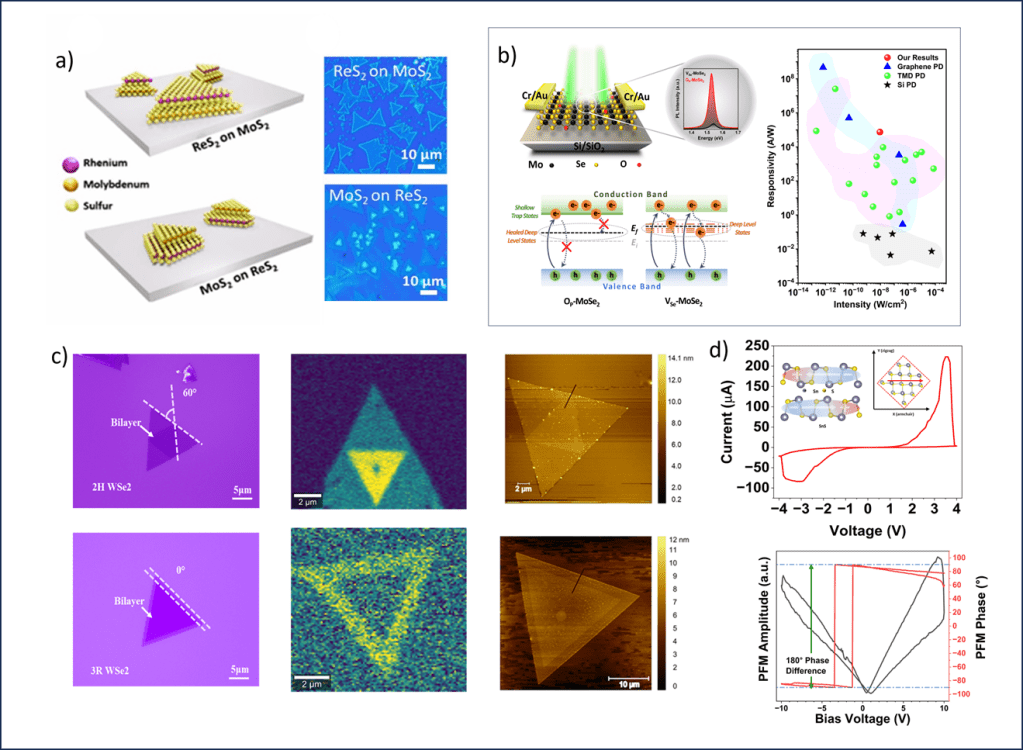
Our laboratory focuses on the design and fabrication of electronic and optoelectronic devices based on two-dimensional (2D) materials, particularly transition-metal dichalcogenides (MoS₂, SnS, ReS2, WSe₂) and their van der Waals heterostructures. By exploiting their tunable band structure, strong light–matter interaction, and atomically sharp interfaces, we engineer defect states, controlled doping, and heterointerfaces to modulate carrier transport and device response. We further explore varied device geometries and systematically investigate their piezoelectric and ferroelectric characteristics to enable coupled electromechanical and non-volatile functionalities. Our work targets high-performance photodetectors and memory elements, with an emphasis on scalability, low-power operation, and integration-ready architectures
References
- DOI 10.1088/2053-1583/acf945 2023 2D Mater. 10 045032
- DOI: https://doi.org/10.1038/s41699-026-00666-5
Flexible and Wearable Sensors for Personal Healthcare Monitoring
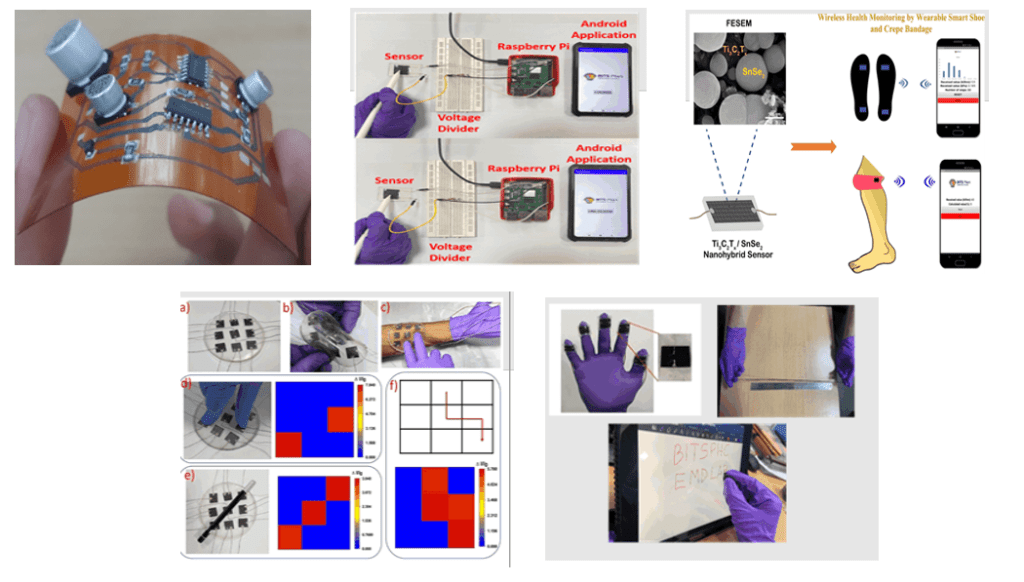
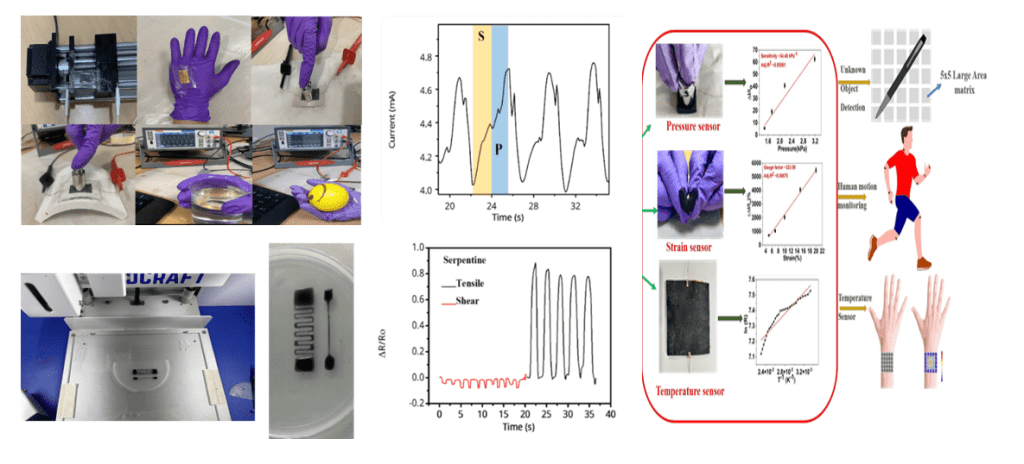
Our lab develops lightweight, flexible sensors capable of detecting physiological signals such as temperature, motion, sweat, and pressure. These wearable technologies aim to support continuous, real-time health monitoring for medical and consumer applications.
References:
DOI:10.1039/D5CC02955D Chem. Commun., 2025, 61, 11158-11186
Next-Generation Neuromorphic Devices and Systems
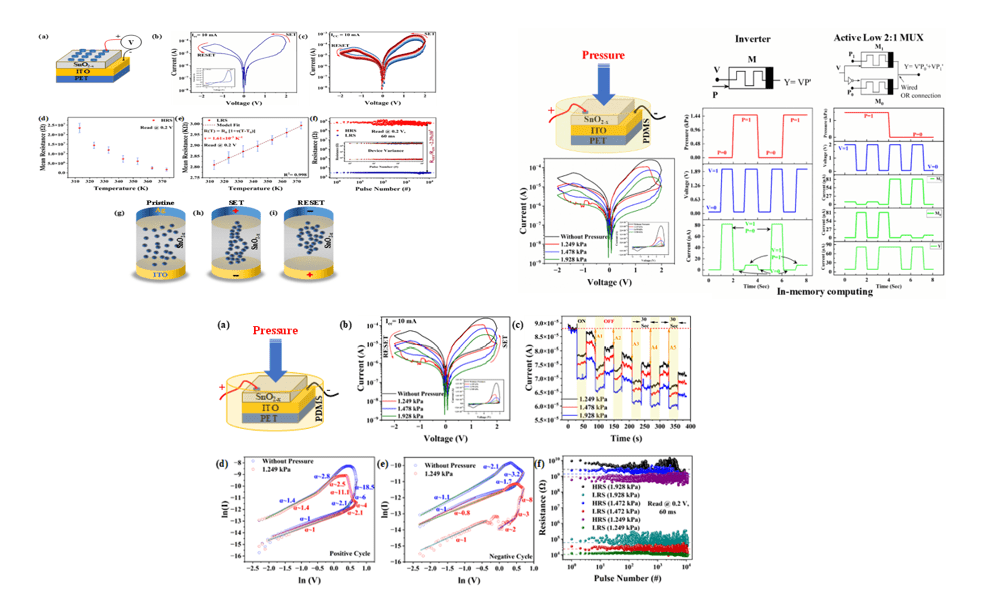
Inspired by the human brain, we design electronic devices that mimic synaptic and neuronal behavior. Using memristive and transistor-based architectures, we target energy-efficient computing systems for AI applications such as pattern recognition, adaptive learning, and edge computing.
References:
DOI:https://doi.org/10.1021/acsaelm.3c01462
Neuromorphic Tactile Sensing
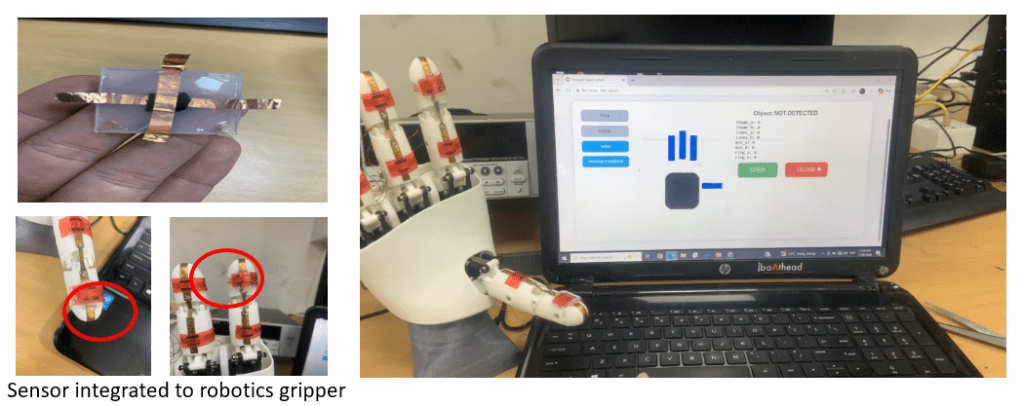
Combining neuromorphic principles with sensor technologies, we develop electronic skin and tactile sensing platforms capable of perceiving pressure, texture, and vibration. These systems are crucial for robotics, prosthetics, and human-machine interfaces
Multimodal Sensors
We engineer sensors that can simultaneously detect multiple stimuli—such as pressure, temperature, light, and chemical signals—enabling comprehensive perception in wearable electronics, smart packaging, and autonomous systems.
Biosensors
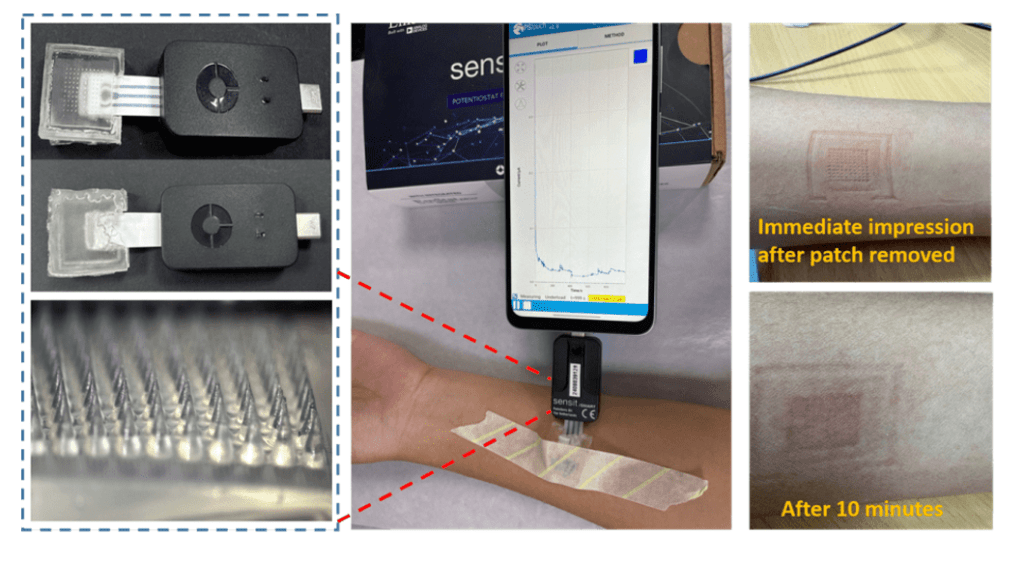
We develop microneedle-based biosensors for minimally invasive, real-time detection of biomarkers directly from interstitial fluid. These systems enable continuous monitoring with high sensitivity, supporting personalized healthcare and point-of-care diagnostics.
Fabrication of Van-der-Waal Heterostructures
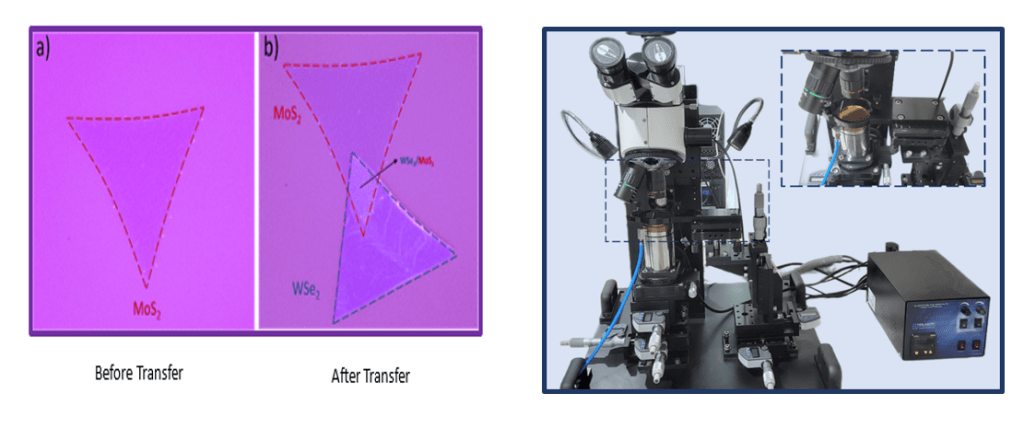
Our lab fabricates Van-der-Waal heterostructures by deterministically transferring CVD-grown flakes using 2D-Transfer setup and, by engineering these heterostructures, we explore properties such as Band-to-Band Tunnelling, intralayer and interlayer excitonics, etc., for developing low-power-consumption and enhanced photodetection applications.
Our lab integrates material science, nano-fabrication, and artificial intelligence to pioneer future-ready technologies. Through strong academic and industrial collaborations, we aim to translate our research into impactful, real-world solutions.

